23 Pieces of Memento Mori Art That Find the Beauty in Death
- gothpersona
- Apr 15, 2025
- 8 min read

One of the most powerful and affecting themes in art, memento mori imagery reminds the viewer that death is always on the horizon. Although it’s a dark subject, artists across time and space have found macabre beauty in the idea of mortality.
Explore this collection of paintings showcasing the memento mori theme in art, and discover why it retains its power to spellbind.
What is memento mori art?
The memento mori is a powerful motif (an idea or design) in art that is meant to remind the viewer of mortality. Latin for “remember you must die,” the phrase is a reminder to live each day to the fullest. In the Christian world, it encouraged the faithful to repent, because you could never be sure when your last day on earth was going to be.
Art that tackles this theme often uses imagery of death such as skulls and skeletons (most commonly), but other images that convey the same idea are: tombs, coffins, extinguished candles, soap bubbles, butterflies, and dead flowers. With its elegant yet gruesome depictions of death, memento mori art is beloved by goths–and anyone with a morbid frame of mind.
Memento mori paintings were most prominent in Western European art from about the mid-14th to the mid-17th centuries, or the 1300s-1600s. However, cultures across the globe have also historically used death imagery to convey the idea that life is fleeting.
Check out these haunting memento mori art pieces from medieval times to the modern era, and prepare to contemplate the eternal:
Medieval Painting Art

This example of a 15th-century illuminated manuscript shows the brilliant colors and gold ink that were used to create intricate, mesmerizing designs in medieval manuscripts. Often (though not in this case), the artists were anonymous monks. This stylized skull is typical of medieval European art, which tended to prioritize the symbolic rather than accurate representations of reality.

This Welsh example of memento mori art presents a highly stylized full skeleton meant to remind parishioners entering a church that their days were limited. Note the hand lifted as if to greet the viewer.

This painting shows a skull at the base of the cross as part of a Crucifixion scene. In this case, the skull is that of Adam, representing Christ’s triumph over sin and death even as it serves as a reminder of the way of all flesh. Fra Angelico is an important figure because he represents the transition from the symbolic, stylized art of the Middle Ages to the more naturalistic painting style of the early Renaissance.
Vanitas Paintings
Vanitas (Latin for “vanity”) is a genre of painting that flourished in Dutch-speaking areas of Europe throughout the 17th century. Artists used still lifes (a term for paintings of objects) with skulls and other materials to explore the idea that life is fleeting, creating beautiful yet morbid tableaux.
The familiar elements of vanitas paintings come together in this elegant composition. The items on the table emerge from a black background as if from the shadow of death itself, with the ominous skull at the center.

This vanitas painting’s angular, simplified forms almost make it look like a Cubist painting that was made 250 years early. In it, the crown of dead weeds creates a striking contrast with the books and gold vessel next to the skull, showing that in death humankind returns to nature.

Once again, rich fabrics and objects of art contrast a simple, elemental skull crowned with weeds in this meditation on the coming of death.
Memento Mori Portraits
From the Renaissance through the 17th century, it was common to see skulls in commissioned portraits. Sitters would contemplate skulls or have one resting nearby as an emblem of piety and a reminder that life is finite.

In this portrait, a young woman with a dreamy expression cradles a skull in deep contemplation. Rather than dreading death, she appears to be embracing it in a composition reminiscent of Death and the Maiden art. It was likely painted in the late 18th century, and you can see that the pose and expression appear very naturalistic.

In this lively portrait, a boy wearing a red plumed hat gestures while holding a skull, as if in mid-conversation. This creates a slice-of-life feeling that emphasizes the stillness and finality of the skull and all that it represents. This was originally thought to be a painting of Hamlet, but scholars now believe it to be a vanitas portrait as there is no record that Shakespeare’s plays made it to the Netherlands by the 1620s.

Baroque Flemish artist Michiel Sweerts was known for his portraits that captured the individuality of their subjects, and this self-portrait is no exception. Here, the artist looks almost startled as he holds a skull in his hands. At the same time, the vague, misty background gives the scene a dreamlike quality.
Skeleton Art

The skeleton is a major motif in a lot of memento mori art, often acting as a personification of Death itself, as in this woodblock print by Hans Holbein. It is part of a series depicting people from various walks of life being taken by Death, who is shown as a skeleton, often playing an instrument or dancing, creating a satirical commentary on death as a great leveller.

In this highly detailed and sumptuous painting, a skeleton looks over a pile of earthly riches. The suit of armor represents conquest, while musical instruments convey the idea that life is fleeting as a song. A king’s crown and pope’s miter join the pile of worldly goods destined for decay–and an hourglass counts down the minutes.

This painting of a young woman depicting her everyday appearance on one side and the skeleton she is destined to become on the other isn’t exactly subtle. However, the details are still oddly charming, like the crown of dead flowers and the delicate rose in her hand.

This late 19th-century painting of skeletons has a lot of personality, as they are given accessories like musical instruments, a broken lantern, and a fan to show off their human attributes. Here, the free style and loose brushstrokes add a sense of spontaneity that contrasts the theme of death.
Calaveras
Calaveras, or stylized skulls, are a prominent motif in Mexican art associated with Day of the Dead festivities. They can appear in everything from fine art, drawings, and etchings to ceramics, papier maché masks, and decorated sugar skulls for children. Whatever form they take, calaveras are a reminder of death with a deep cultural significance.

Posada was a master of calavera art, often creating satirical drawings that were printed in newspapers. In this work, the familiar story of Don Quixote by Miguel de Cervantes gets a morbid twist as the man of La Mancha–and his horse–take on a skeletal form.

Orozco was a famous Mexican Modernist known for his political murals, which often featured skeletons and death imagery. In this calavera painting, possibly a study for a larger work, the plumes surrounding the skull give it a festive appearance that is at odds with the grotesque subject.

These dazzling ceramics with intricate decorations illustrate the beauty and diversity of calavera folk art.
Kusozu Paintings
In the Japanese Buddhist tradition, kusozu paintings depicting nine stages of bodily decomposition encouraged viewers to contemplate mortality for centuries. Their subjects were often royal or highborn, showing that death comes for everyone regardless of social status.

This series begins with the noble lady in her lavish bed and ends with her bones scattered in the grass. Scholars have suggested that the lady is meant to be the 9th-century poet Ono no Komachi, but regardless of its subject, the ending is the same. Painted in the Tosa or Kano school, these sometimes gruesome watercolors are meant to remind the viewer that earthly bodies are fleeting.

This simple, elegant painting depicting bones in the grass is the final stage in a kosuzu cycle from 18th-century Japan. Here, the green, vibrant grass contrasts the fragile bones strewn throughout the field, highlighting the beauty that is fueled by decay.
Modern Memento Mori Art

Reclusive and misanthropic, Belgian artist James Ensor was obsessed with depicting the worst of humanity. Skeletons, grotesque images, and the Seven Deadly Sins would be recurring motifs in his work that seethes and vibrates with unsettling energy. Here, the blue skies and brightly colored hats and clothing are an ironic contrast to the skeleton figures.

Cézanne is an important figure in Western art history, as his work bridges the gap between post-Impressionism and important 20th century modern art movements like Cubism. Here we can see the impulse toward an Expressionist sense of movement and energy as the skull is rendered in just a few sketched lines. Watercolor in the background helps to bring the skull forward.

This skull painting puts a Modernist spin on a classic vanitas composition. A still life featuring a shell, a book, a feather in a vase, and a skull translates the concept to the 20th century, with soft forms rendered in a realistic yet stylized way–and a hidden portrait of the artist amid the reminders of death.

This dynamic still life places a simple skull font and center, using abstract forms and colorful draped fabric to add visual interest. A color palette with warm red tones and the suggestion of afternoon sunlight gives the piece an almost cozy feeling despite the dark subject matter.
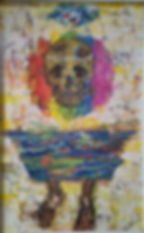
This unusual self-portrait shows the artist’s feet and skull crowned by an all-seeing eye. The juxtaposition of the skull and the colors of the rainbow provides a sense of hopefulness, as does the blue form possibly representing water and resembling wings. In this highly symbolic painting, death and joy walk hand in hand.
This collection of memento mori art shows how this motif has evolved with changing times while retaining a prominent role in centuries of art history. As long as humanity is preoccupied with death, it’s sure to remain a central theme in visual art for years to come. Life might be fleeting, but the memento mori never dies.